

Duncan Aviation has partnered with Razorleaf to automate its product lifecycle management (PLM) workflow, cutting project-scoping time by 75% and improving data access across departments involved in business jet interior refurbishment.
The company, which is the largest privately owned business aircraft MRO provider in the US, operates three major maintenance, repair and overhaul facilities in Michigan, Nebraska and Utah, along with regional shops and mobile teams. It provides nose-to-tail services for private and commercial business jets from manufacturers including Embraer, Gulfstream, Textron, Dassault and Learjet.
“We are a one-stop shop,” says Aaron Lane, alterations planning team/certification coordinator/PDM administrator at Duncan Aviation, located in Lincoln, Nebraska. “We do everything but build planes from scratch. Duncan Aviation is an innovative company, always embracing new technologies, new ways of doing and thinking about business. Our major facilities provide nose-to-tail services for global private aircraft, including Embraer, Gulfstream, Textron, Dassault, Learjet, and others. Every imaginable repair and upgrade is done.”
Duncan Aviation’s engineering and certification group handles customer-driven modifications to cabins and cockpits, ranging from replacing older dial-and-gauge displays with glass touchscreen controls to modernising lighting, sound systems and connectivity upgrades such as Starlink or Gogo.
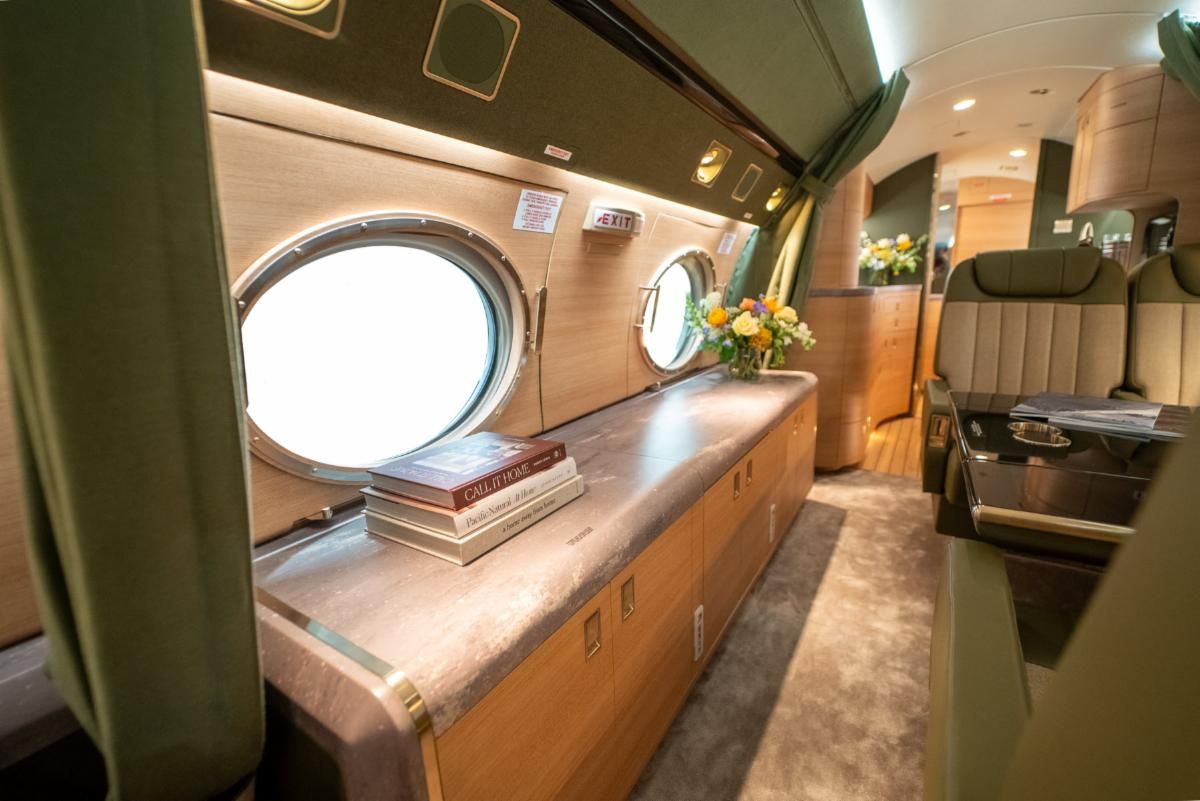
One recent project involved a Gulfstream V, for which Duncan Aviation’s design team collaborated with BorromeodeSilva, a product-development firm, to create a yacht-themed interior featuring porthole windows, deck-grade wood flooring, two-tone seating with green and almond-gold accents, and refreshed surfaces and cabinetry. The design work moved from digital renderings into the 3D CAD and ERP software Duncan Aviation uses to generate technical data for production and FAA certification.
“There are very stringent rules for safety of the aircraft,” says Lane. “It’s our job in Engineering and Certification to understand what those rules are, design to those rules, inspect the product regularly, and guarantee that design and outcome match.”
Customer projects begin in Duncan Aviation’s ERP system, where sales teams generate quotes accessible through a customer portal. The quotes are then shared with engineering and certification teams and become the foundation for projects set up in the company’s Aras Innovator PLM platform, with APIs connecting the two systems.
“The official work scope generated by our ERP system is the document that everyone in Duncan Aviation then uses,” says Lane. “We take that information and translate it into engineering tasks. The departments meet around it and nail down the interrelated factors that arise from the choices made by the customer.”
A central element of the workflow is the project data list (PDL), which holds all parts, documents, design data, analyses and reports originating from the ERP sales and project-scoping process. These items compile into a master data list (MDL) forming the technical data package (TDP) that is delivered to the customer and regulatory agencies.
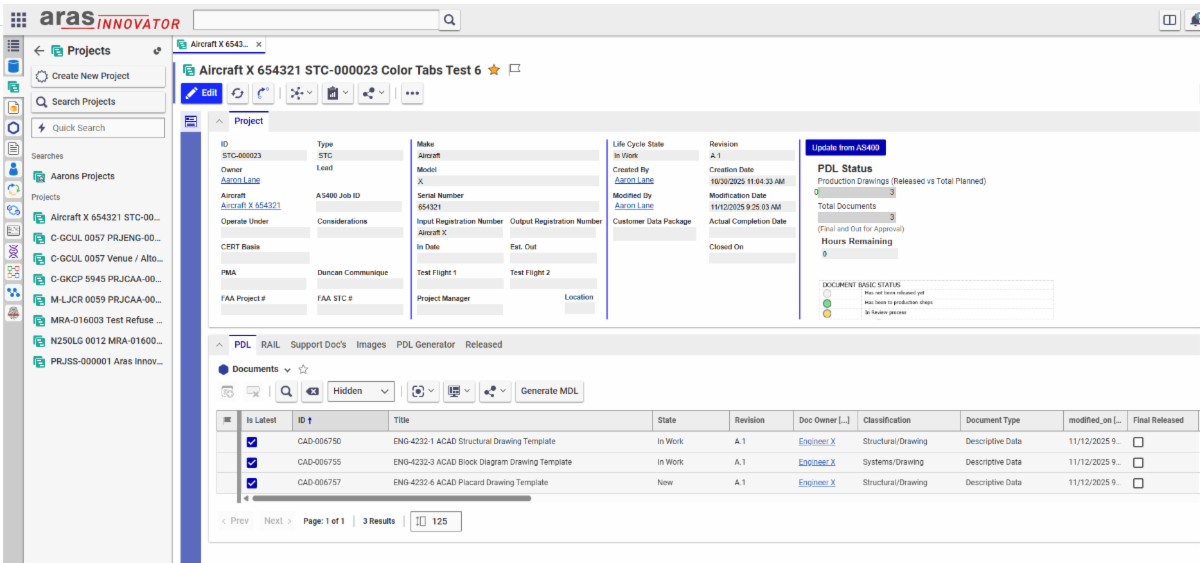
Previously, creating a PDL was a manual process requiring each element to be entered by hand with identification numbers assigned individually. Aras recommended Razorleaf, a partner specialising in PLM implementation and middleware development, to automate the workflow. Razorleaf developed code and logic that uses templated pathways to capture known project requirements and streamline data entry within the PDL.
“We got the coding project going with Razorleaf and it went quickly,” says Lane. “They knew ARAS software and understood how to custom automate it for our specific purposes. Very impressive.”
“Today, 99 percent of our documents and drawings have templates. It’s where the engineers start off. The templates are found via the PDL generator tab. We have everything from CAD documents, made assessable there, to flammability test plans and reports, analyses, instructions, and meta-data, all generated now in timesaving batches.”
“In fact, time-savings wise, our productivity in managing the scope of projects has conservatively improved by 75 percent. Plus, add to that, everyone at Duncan Aviation has speedy access to the project data. This includes procurement, production, quality, sales, and management. The PDL is the source for everyone.”
Duncan Aviation is now expanding its digital capabilities, with recent enhancements including change orders and engineering orders and requests. The next phase will target the bill of materials, procurement processes and workload management.
“We want to automate how the PDL within Aras Innovator interacts with our separate ERP software, and basically reduce human involvement, when appropriate,” says Lane. “This extends to workflow management. The workflows by themselves have greatly enhanced our work environment. That’s on our side of things.”
“On the other side, the aircraft industry as a whole generates a tremendous amount of paper for worldwide regulatory agencies,” he notes. “It’s a long-term goal of ours to get Aras Innovator configured enough to convince the FAA that they don’t need paper copies from us. Digitization and automation will help everyone.”
Images: Duncan Aviation