

Designed by Lufthansa Technik and Designworks, a BMW Group company, The Bow concept is aimed at facilitating both conviviality and individual rest for high-profile group travel.
Although Lufthansa Technik has its own in-house design department, it also has a history of collaborating with external design companies to ensure its products “remain at the cutting edge of contemporary design”, explains Egbert Pusch, director of sales for Lufthansa Technik’s VIP & Special Aircraft Services unit.
Perhaps its most notable collaboration to date was with Mercedes-Benz in 2015, which resulted in a striking helix-inspired VIP widebody concept. Lufthansa Technik decided to repeat this success by teaming up with another powerhouse of German engineering and design: Designworks, a BMW Group company.
Designworks was founded in 1972 and acquired by the BMW Group in 1995. It provides design and consulting services for its parent company, of which the core automotive brands are BMW, Mini and Rolls-Royce. The idea this time was to combine Designworks’ extensive expertise in the fields of luxury, technology, ergonomics and experience design, with Lufthansa Technik’s decades of experience in VIP and special mission completions, as well as its technologies.
“Designing spatial experiences is a fascinating field for us, one we explore across many dimensions: on the road, on the water, and with The Bow once again in the skies,” comments Annette Baumeister, director of Designworks’ studio in Munich, Germany. “With Lufthansa Technik’s new cabin concept, the journey becomes a destination in itself.”
Group travel
While the Mercedes-Benz project was a more traditional widebody concept tailored for a single VIP and entourage, The Bow is specifically designed for narrowbody aircraft and shifts the focus to ‘shared exclusivity’ – that is, group travel.
“We were inspired by the growing demand for flexible, design-driven private travel solutions for high-profile groups, who require a seamless balance between collaborative spaces and private retreats,” says Pusch.
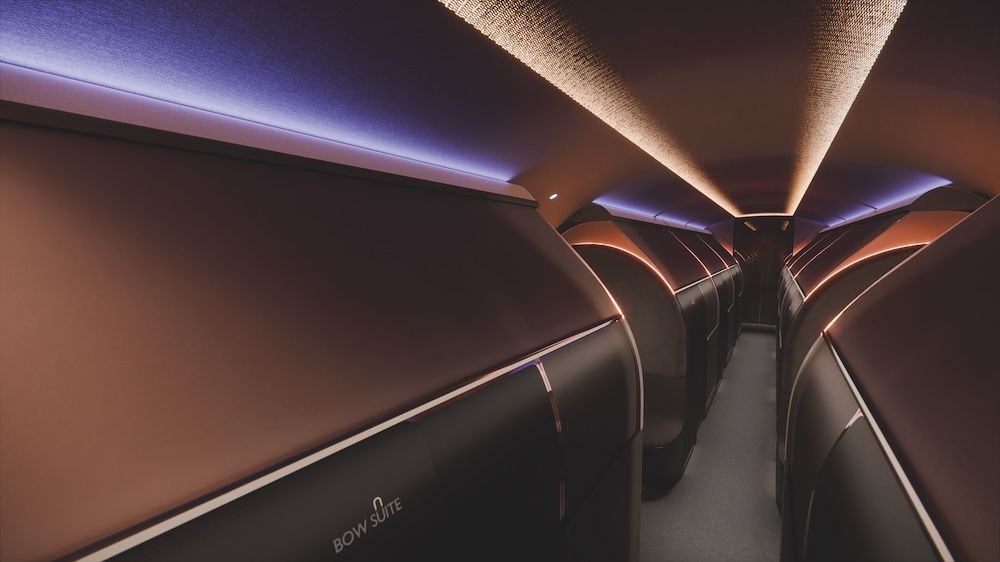
The Bow is designed to allow high-profile groups to travel together while maintaining control over their personal privacy. The layout is modular and fully customisable; nothing is set in stone. The cabin is structured into three signature zones: the reception and lobby area, the transformative lounge, and the private Bow Suites.
A warm welcome
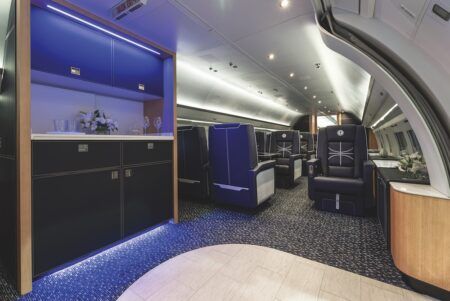
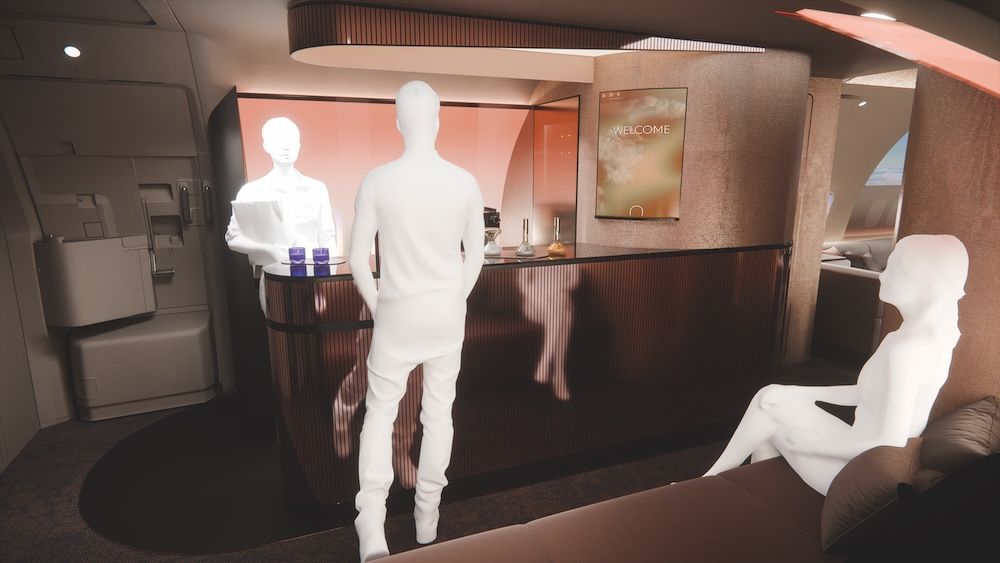
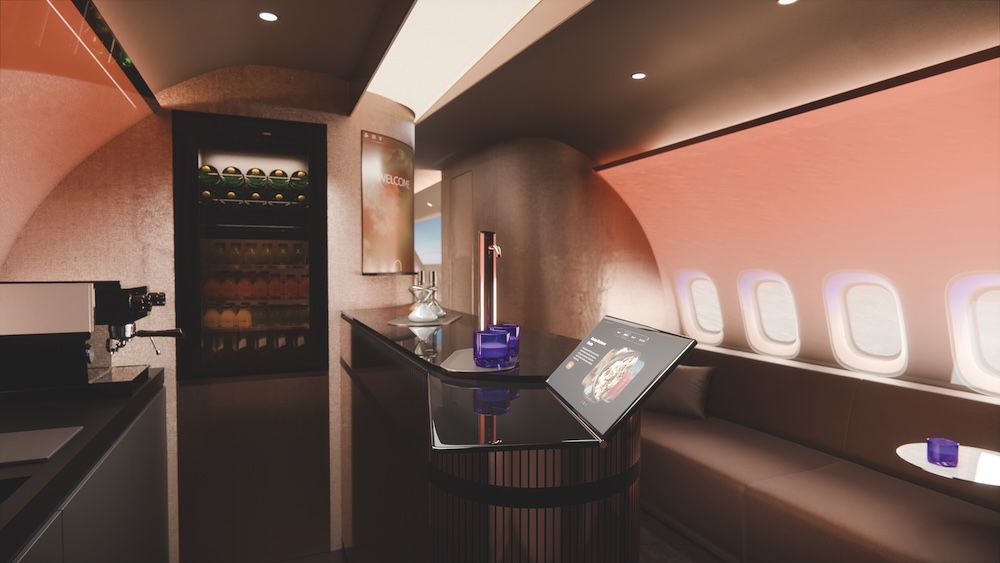
Pusch describes the reception and lobby area as “a welcoming entrance featuring curved architectural forms, premium materials, a hospitality-driven bar environment, and integrated technology like a gradient screen and a foldable, interactive service table”.
The bar is intended to act as a reception desk, a professional backdrop for media interviews, a casual bar for socialising, or a quiet resting spot for the crew on long flights. It also incorporates Lufthansa Technik’s curved OLED screens and Hidden Touch surfaces.
Flexible lounge
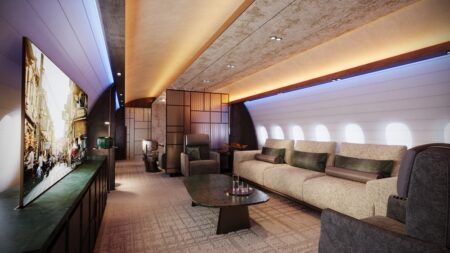
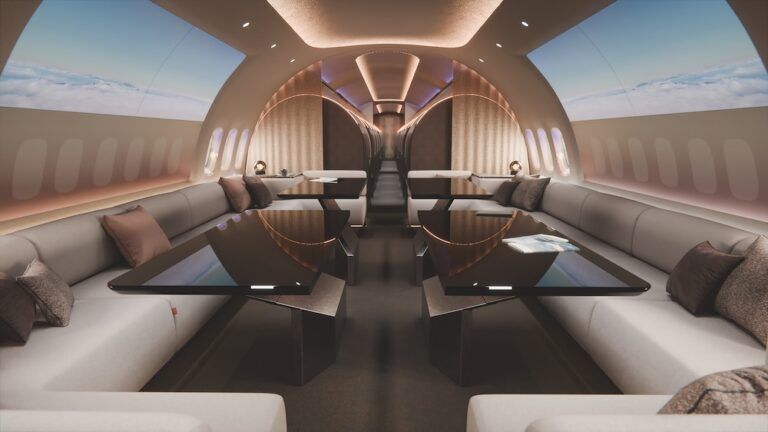
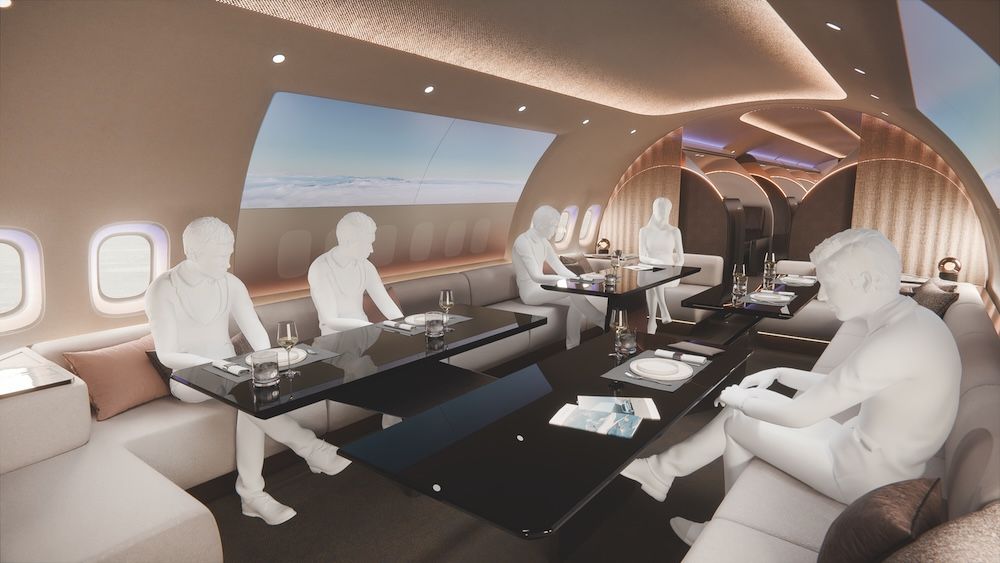
The lounge features two large, curved screens and a large, modular presentation table system that can divide into four individual tables. This allows the space to adapt from facilitating large team gatherings to smaller breakout conversations. Lufthansa Technik also expects this modularity to facilitate easier boarding and common use of the shared space.
“The screens create an immersive environment for analysis, presentations or entertainment,” explains Pusch. “Depending on their specific requirements and preferences, clients can customise the configuration with alternative curved screen layouts, opt for a screen-free design or combine with other Lufthansa Technik innovation products. This area also transitions seamlessly from a high-tech boardroom to a fine dining setup.”
Private suites
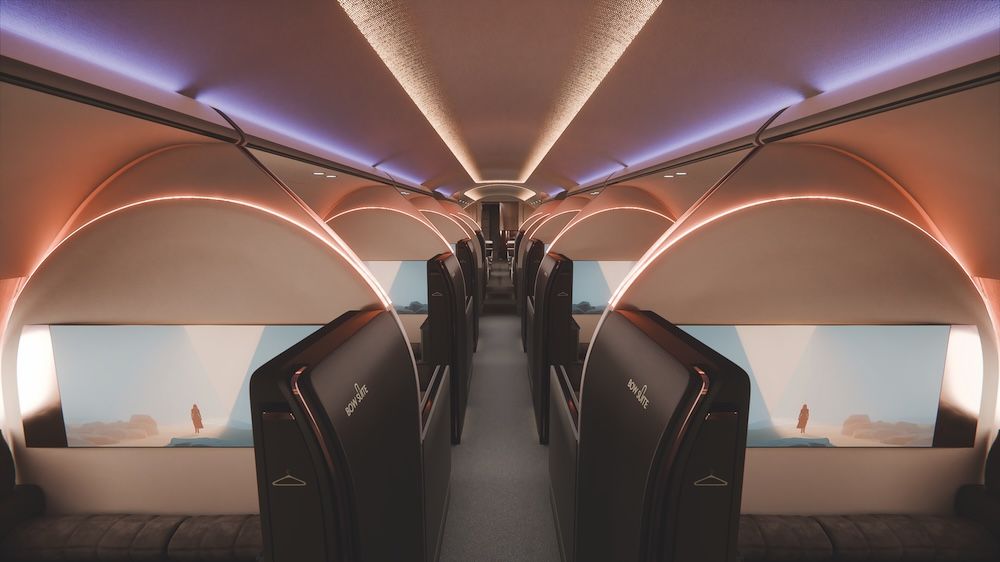
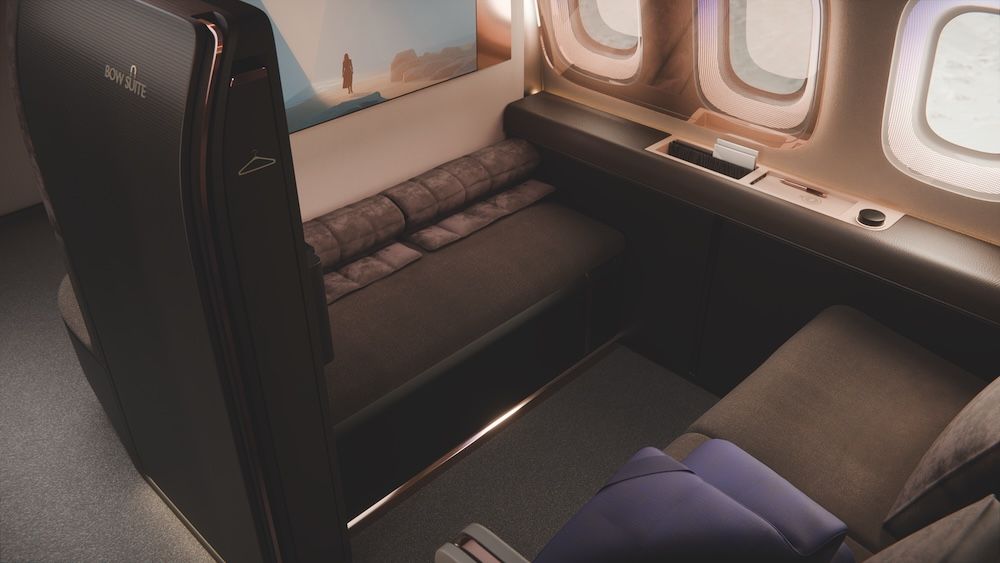
Finally, the private Bow Suites feature soft, organic shapes, acoustic shielding, mood lighting, scent options and storage solutions. Each suite accommodates one traveller and has a guest seat, allowing passengers to choose between working or resting individually, or hosting a colleague.
“The recurring arc motif is the visual and functional signature of the cabin, present even in the galley design,” adds Pusch. “By mimicking the natural curvature of the aircraft fuselage, these soft, progressive forms create a protective, cocoon-like atmosphere. They convey a sense of safety, privacy and harmony, while housing integrated technologies like acoustic shields and ambient lighting.”
“Blending monumental architecture with transformative spaces, The Bow fluidly shifts between intimate retreat and open social experience,” comments Tommy Forsgren, lead designer at Designworks’ Munich studio.
Technological showcase
The entire cabin is orchestrated by Lufthansa Technik’s Red Dot Design Award-winning »nice« (Network Integrated Cabin Equipment) CMS platform, allowing passengers to control functions such as lighting, the climate, seating and multimedia.
The Bow is not only a design concept but also serves as a platform to showcase how Lufthansa Technik’s in-house technological developments can interface directly with passengers in a luxury environment.
Hidden Touch technology is integrated in multiple places, including welcome panels in the lobby and galley areas, the large presentation table in the lounge, and a dedicated version that folds into seat armrests. It also features in the folding tray table (the »nice intellitable«) within each private suite, where high-definition touchscreen functionality is embedded directly into the haptic surface.
“This technology allows passengers to operate a wide range of cabin functions through sleek control panels that completely disappear into the surrounding interior materials when not in use,” says Pusch.
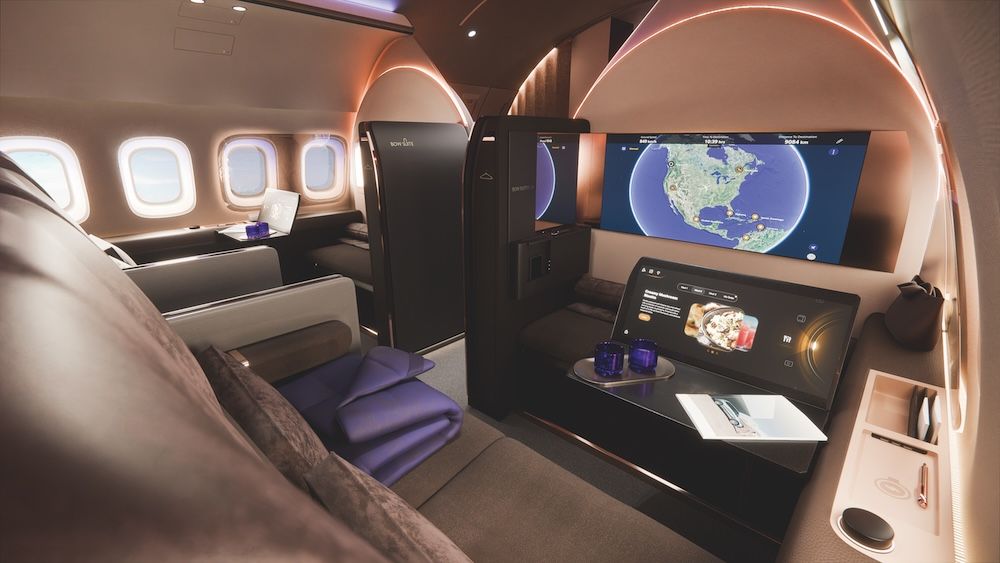
Certain elements of The Bow are conceptual technologies that are still under development. Pusch shares that the most technically ambitious example is the transformative presentation table that divides into four individual tables. This table is a design concept rather than a technically validated feature at this stage, and remains one possible configuration among several options. The renderings showcase the current level of definition.
“While the mechanical system enabling tables to extend and retract is not yet certified, we are confident in our ability to bring it to certification based on our extensive in-house engineering expertise,” says Pusch.
Similarly, the »nice intellitable« foldable tray table with integrated Hidden Touch technology is currently still under development. “We are working toward full certification to ensure it meets the rigorous safety and performance standards required for business aviation,” says Pusch. “The Bow deliberately showcases not only what we can deliver today, but also what we are capable of engineering for tomorrow.”
Further development
The Bow was officially launched at Aircraft Interiors Expo in April 2026 with a ‘classic’ layout. The initial feedback from customers has been “overwhelmingly positive”, Pusch says. “We are incorporating this valuable feedback to refine and expand the concept further,” he adds.
The Bow is fully intended for market realisation. “We look forward to working with visionary clients to bring this next generation of group-centric VIP travel to the skies,” says Pusch.
“Together, Lufthansa Technik and Designworks created a refined world of luxury, shaped by adaptive architecture and gentle technological whispers, unfolding as a seamless journey, setting a new benchmark for group VIP luxury in the sky,” comments Tithima Supavanichyanont, director of design and creative consulting at Designworks’ studio in Munich.
“The future of luxury is active, emotional and experiential,” Supavanichyanont adds. “Building on decades of experience with the BMW Group brands and VIP travel projects such as The Bow, we’re exploring the intersection of sportivity, luxury and brand experience.”
Images courtesy of Lufthansa Technik
This feature was written by Izzy Kington and first published in the September/October 2026 edition of Business Jet Interiors International. To read the full feature, click here.