


Aircraft Interiors Expo (AIX) has published a report on the trends shaping cabin interiors in the Middle East, outlining what it says airlines, OEMs and suppliers must focus on now to remain competitive in one of the world’s most influential aviation markets.
The report suggests that the Middle East is not only a high-growth market, but also a global benchmark-setter for premium, digitally enabled and culturally rooted aircraft interiors.
Drawing on perspectives from regional and global industry leaders, including Emirates, Qatar Airways, Etihad Airways, Riyadh Air, RoyalJet, F/LIST and Gogo Business Aviation, AIX’s report provides insights into how carriers and business jet operators are actively reshaping the passenger experience.
What operators must focus on
The report describes the Middle East as an emerging leader in cabin interiors. Valued at US$1.4 billion in 2025, the region’s commercial aircraft cabin interior market is forecast to exceed US$2 billion by 2031. According to the report, success in the region will depend on understanding several defining shifts:
- Premium is the baseline, not the exception
With nearly 15% of passengers flying business or first class in 2024, the highest share globally, premium is not a niche offering in the Middle East; it is the commercial foundation. “Premium travel remains a key differentiator for the region, while competition amongst airlines in the Middle East for the premium traveller’s business continues to be intense,” said Anita Gradwohl, group director of customer relations and sales, F/LIST. Airlines are designing fleets around high-yield cabins, fully enclosed suites, elevated premium economy and even lie-flat narrowbody products. For suppliers, this means innovating first for premium, then cascading down, not the other way around. - Cabins are strategic capital investments, not cosmetic upgrades
In the Middle East, interiors are viewed as long-term brand assets. “Cabin interiors are no longer treated as a cosmetic cost centre, but as a strategic capital investment that drives brand authority, geopolitical signalling and long-term asset value,” explained Edése Doret, founder and president, Edése Doret Industrial Design. Flag carriers are investing billions in retrofit and next-generation cabin programmes. - Flagship innovation sets, and resets, global benchmarks
The region has repeatedly redefined the business and first-class experience, from fully enclosed suites with sliding doors to multi-room concepts and salon-style layouts influenced by hospitality traditions. This innovation is no longer confined to widebodies. Premium expectations now extend across narrowbody and medium-haul fleets, demanding consistent brand delivery across all aircraft types. - Digitalisation must be seamless, upgrade-ready and invisible
Passengers in the Middle East expect their onboard digital experience to match, or exceed, life on the ground. “Connectivity in the Middle East is much more than an expected service; it is essential,” said Dave Falberg, senior VP Sales EMEA/APAC, Gogo Business Aviation. High-speed, multi-orbit connectivity, AI-enabled personalisation, 4K OLED screens and smart cabin controls are becoming standard. However, technology must be integrated discreetly. Cabins need to be architected around upgrade-ready connectivity ecosystems that protect long-term investment and allow for rapid evolution. - Wellbeing and ‘quiet luxury’ are redefining the design language
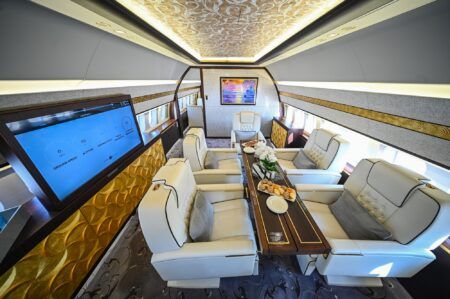
There is a notable shift away from overt opulence towards refined, culturally resonant luxury. Airlines are investing in circadian lighting, advanced acoustics, improved air quality, tactile materials and varying levels of privacy to create restorative, hospitality-led spaces. Cabin layouts increasingly reflect regional social norms, including face-to-face seating, multi-zone configurations and family-oriented spaces, making aircraft interiors feel more residential. - Sustainability is engineered in, not marketed loudly
Rather than surface-level eco messaging, sustainability in the region is embedded into engineering decisions. Lightweight materials, modular architecture, upgrade-ready components and responsible sourcing are being integrated into premium cabins to reduce lifecycle impact without compromising craftsmanship. For long-haul operators in particular, fuel efficiency, durability and certification discipline are central to future cabin strategy.
With around 800 aircraft currently in collective orderbooks and Boeing forecasting demand for 1,370 new widebodies over the next 20 years, Middle Eastern carriers will be able to design next-generation cabin concepts from entry into service, and embedding these differentiating factors at fleet level rather than retrofitting ageing aircraft.
“The Middle East continues to set the pace for premium cabin innovation globally,” commented Archana Dharni, event director at AIX. “From digitally enabled personalisation to culturally nuanced design and long-haul comfort leadership, the region consistently challenges conventional thinking.”
Many of the companies referenced in the report will be exhibiting at AIX 2027, which will take place at Hamburg Messe from 6 to 8 April.
The third in a global insight series
Commissioned by AIX and authored by aviation journalist and Middle East specialist Chloe Greenbank, the Middle Eastern market report is the third instalment in the AIX Global Cabin Concepts Lab series, exploring regional trends shaping the future of aircraft interiors. Following earlier reports examining the APAC and Indian markets, the series brings together regional perspectives on how airlines, operators and suppliers are approaching cabin innovation, investment and passenger expectations. A fourth report, focusing on the US market, will be released ahead of AIX 2027.