

Lufthansa Technik explains how it has evolved its Hidden Touch Display technology to embed HD touchscreen functionality into a folding tray table surface.
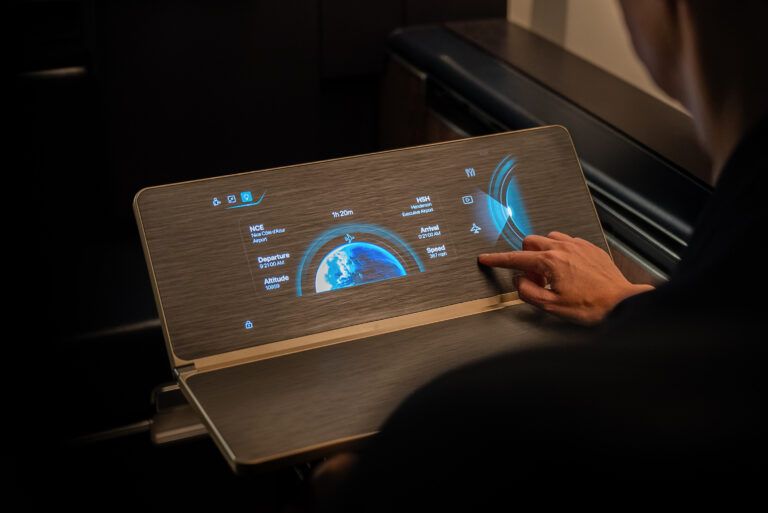
Lufthansa Technik’s Hidden Touch Display technology – revealed earlier in 2025 in a wall-mounted application – has been evolved and miniaturised. With the nice (networked integrated cabin equipment) intellitable concept, HD touchscreen functionality is integrated into a folding tray table surface.

“Integrating a touch display into this highly complex and stressed component, with moreover very limited design space, posed a major challenge and required several iterations of prototypes to arrive at the current solution,” says David von Holt, technology development engineer at Lufthansa Technik’s Original Equipment Innovation business unit. “Nevertheless, we deliberately selected such a challenging technical environment. Our goal simply was to gain as many insights as possible for other integration ideas we might pursue in upcoming stages of development.”
The tray table can be moved along the longitudinal axis or one half can be folded upright. “Each position could potentially create very individual exterior lighting conditions that have to be taken into account when ensuring optimal brightness and readability of the displayed content,” notes von Holt.
The surface must withstand knocks and spills, and has been successfully tested in regards to its resistance against direct sunlight, heat, scratches and a number of liquids and creams, von Holt says. The surface is sealed against the ingress of liquids in the frame area. Further long-term application-specific tests, such as repetitive movements of porcelain tableware, are also in preparation.
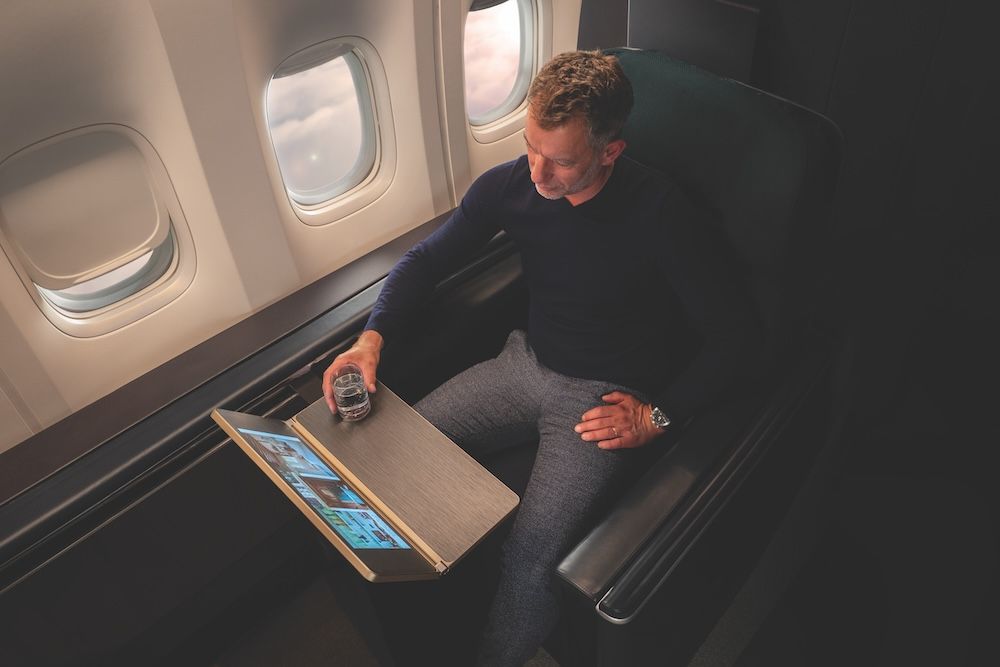
Demonstrated functionalities of nice intellitable include a moving map, seat adjustment controls, a food and beverage ordering system, music and video players, and a digital magazine flip book. Display functions appear and vanish when prompted by the passenger, and can be minimised to the edge.
A demonstrator showcased at Dubai Airshow attracted broad attention. “This intensive dialogue with potential customers was not only met with very positive feedback on the two demonstrated use cases (wall panel and tray table), but also yielded new ideas for future applications of this technology, which we are now analysing in greater detail,” says von Holt.
The development of a first series application could start shortly after a launch customer comes on board with the respective funding, he explains. From that point, Lufthansa Technik estimates a timeline of 18 to 24 months until a first viable series product emerges – depending on the desired integration position and functionality.
This article was written by Izzy Kington and first published in the December 2025/January 2026 edition of Business Jet Interiors International as part of a look back at some of the most interesting developments of 2025.