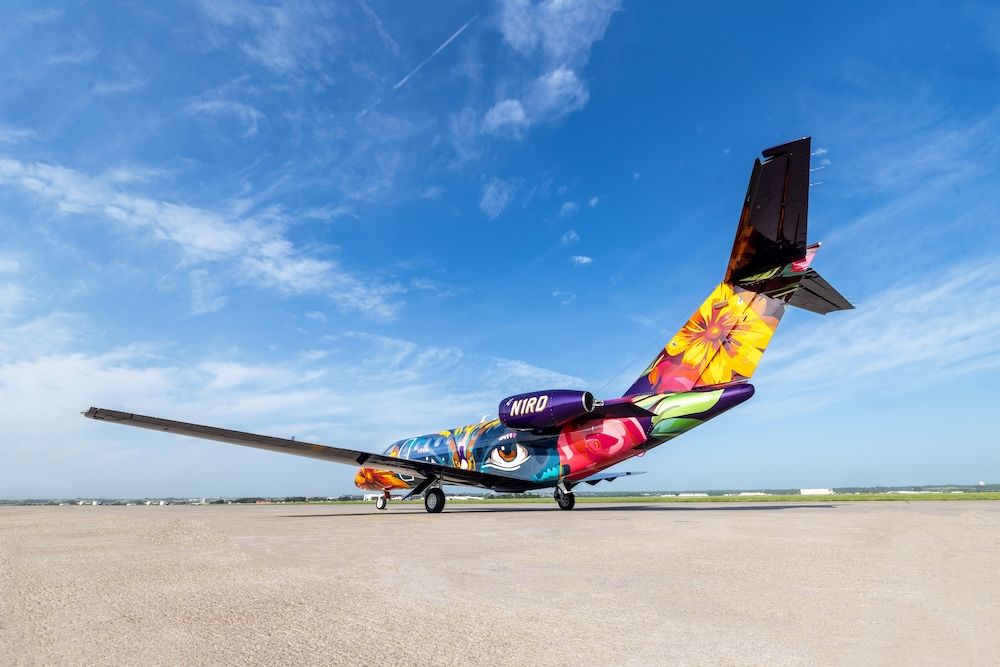

The first aircraft to be painted at Duncan Aviation’s new paint hangar, at its site in Lincoln, Nebraska, has been unveiled. The company said the Citation CJ3+ aircraft’s new scheme is “the most intricate paint design” it has ever completed. It features 46 colours, with details including eyes and flies.
The aircraft, registration N1RD, is owned by the Duncan family. Before the project – which began two years ago – it sported its factory paint job, white with stripes.
Former company president Robert Duncan (now retired) and his wife Karen Duncan challenged the paint and design teams to submit ideas for “something crazy” and bold – a scheme that could not be mistaken for anyone else’s. “They know our sense of adventure, our sense of creativity,” said Robert Duncan. “We want that to reflect in what we fly, because that’s what Duncan Aviation is known for. Out on the edge, trying different things, experimenting, but doing it in a first-class way.”
There were roughly 30 initial scheme submissions, and ideas were developed taking the Duncans’ feedback into account. Finally the Duncans selected a design from paint master specialist Troy Reinke, drawing on Mexican art and culture connected to the family’s ties to Puerto Vallarta.
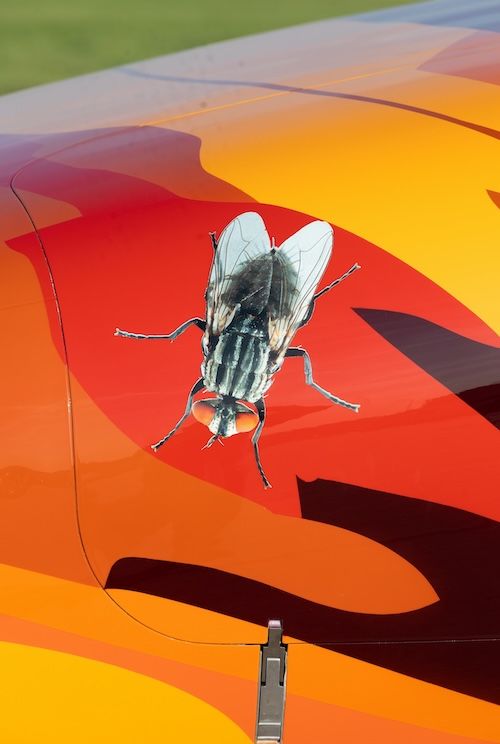
Among the details are fly motifs on the tail, nose and nacelles – small compared with the full sweep of the paint scheme, but they became defining features. The eyes are another standout element. “The eyes are really distinctive,” said Robert Duncan. “They jump right out at you.”
Reinke’s original artwork included fades that would not work the same way on an aircraft as they did on paper. They had to be converted into solid shapes that could be masked and painted. “I took Troy’s drawing and split that out into individual shapes and pieces,” said lead designer Hannah Mann. “His original scheme had fades and highlights and shadows, and when we broke those out into individual shapes, we had to add those design elements back in. That’s where the 46 colours came from.”
Each colour added complexity. Every section had to be individually planned, masked, painted, unmasked and protected with precision. “With the number of colours that we have on there, we knew that every single colour was going to have to be masked and unmasked,” said Angie Coleman, completions sales representative. “So, we sat down with the team, went over how many labour hours this was really going to take, and where we could fit it in the schedule.”
Paint team leader Brandon Boyer said the project ran alongside the team’s other work. “Just because we had this airplane to paint, we didn’t put everything else aside,” he said. “We still had our core aircraft to paint and give the same amount of attention to.”
That planning continued in a new space built for the future. Robert Duncan wanted the CJ3+ to be the first aircraft painted in the new Lincoln hangar. “I’m really proud of the way that hangar turned out, and it’s special to have this as our first paint job,” he said.
Troy Reinke said the new facility helped to support the work. “It’s bigger, it’s more open, it’s bright in there,” he said. “It’s definitely helping.”
Boyer added that the space’s full climate control was useful during the project, which took place in temperatures of 100°F. “As hard as it was, it was great to have air conditioning,” he said. “It was super easy to control temperatures.”
Robert Duncan said the hangar reflected the company’s growth, capability and confidence in its people. “It means that we’re growing and expanding and that we can paint bigger airplanes,” he said. “The hangar is terrific.”
Troy Reinke estimated at least 25 team members contributed to the project across layout, paint, project coordination, sales, design and leadership support.
Boyer credited paint crew team leader Trevor Reinke – who led the day-to-day paint effort – with helping keep the project moving while the team also supported two or three other aircraft simultaneously. “Trevor ran the day to day and did a phenomenal job,” Boyer said. “The team really stepped up and kept everything rolling.”
Project manager Tony Chipman, who coordinated communication during the project, said that at times, there were as many as 10 people working on and painting this aircraft across multiple shifts. “That kind of collaboration required patience, communication and trust,” he says. “Even when the work was challenging, the team stayed focused and continued to show up for one another.”