


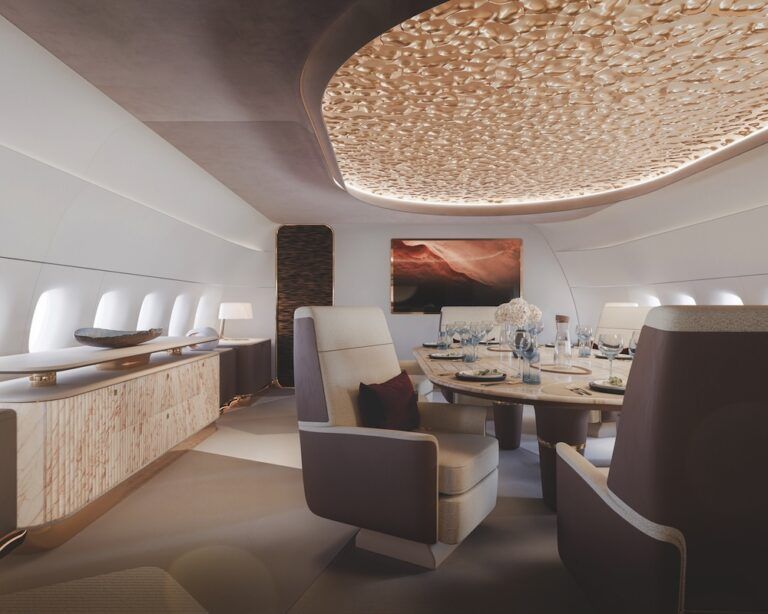
Christoph Fondalinski, VP of completions at Jet Aviation, discusses the company’s approach to cabin lightweighting – from setting a target to material considerations.
How important is lightweighting to clients and why?
Since 1977, Jet Aviation has been crafting beautifully customised aircraft interiors. We are one of the most experienced centres in the world, with a design studio, engineering, production and installation all on-site and in-house at our completions centre in Basel, Switzerland. As a result of our commitment to exceptional craftsmanship, innovation, and to pushing the boundaries of what is possible in VIP completions, we are redelivering some the lightest and quietest wide- and narrow-body aircraft flying today.
Each of our completion projects is completely bespoke, designed, engineered and manufactured to meet the specific requirements of an individual customer. Of course, there are some general trends which we are seeing, including requirements for cabins to be both quiet and light. Weight is always an important criterion for our customers, enabling them to fully enjoy the cabin environment, while still maximising their aircraft in terms of range and efficiency.
How are target weights estimated in the specification stage?
Weight estimations are generally established using a variety of factors, including benchmarking historical data, range requirements of the specific aircraft and layout.
What materials aid you in lightweighting?
One key contributor to the weight of a cabin can be acoustic treatments. Traditionally a quiet cabin has required a large amount of soundproofing, contributing to the weight.
Our teams have been researching the balance of sound and weight for over a decade, working closely with our own design, production and installation teams, and our customer, to develop sophisticated modelling techniques that can estimate the effects of different materials or layout choices in advance, and predicting acoustic and weight values before the cabin even goes into production.
Our most recent redeliveries are testament to this, achieving sound levels below 40dB SIL in the cabin areas while also exceeding customer expectations on weight. We are very proud to be setting a new standard in acoustic and weight performance for VIP completions.
The materials we use throughout the cabin also play a part in the final weight. Our design, engineering and production teams work together closely, and with the customer, to define the best options to meet a customer’s expectations, both in terms of final finish and cabin performance. These can include finding new ways of fitting interior systems to reduce noise, exploring new sound-dampening materials, decorative materials, seat foam and newer, lighter-weight technologies for panelling or cabinets.
In 2023, we also launched a new bio-resin for use in non-structural parts, and we continue to explore alternative materials that show potential for enhancing the performance of the cabin in line with our customers’ needs, whether those are sound, weight or providing more sustainable material options.
What manufacturing techniques and technologies help in lightweighting?
Across VIP completions, there are a wide range of manufacturing processes and techniques that support lighter-weight cabin production, such as advanced composite processing, additive manufacturing or bonding.
At Jet Aviation, we are also fortunate to have almost all aspects of our completions business on-site, allowing our engineers, designers and craftspeople to work together closely to define the best methods and materials to continually push the boundaries of what is possible in VIP completions, including optimising weight for our customers.
What other developments would you like to see?
We are committed to continuous improvement and innovation and constantly collaborate with our teams and partners to push the boundaries of what is possible in VIP completions. As we continue to strive for ever-lighter cabins in service of the requirements of our customers, we see potential for even greater collaboration to support our suppliers and partners in delivering new material solutions for VIP business aviation cabins.
Our engineering team includes a certification department, and we have worked closely with suppliers to certify materials not traditionally or previously used in aviation to enable further innovation in design and engineering. For example, in the development of our in-house inflight entertainment and cabin management system, IFX, where we certified supplier hardware for use in the aircraft cabin.
What factors need to be considered in balance with lightweighting?
When considering the weight of an aircraft, there are key factors to be considered, such as safety requirements, aircraft operational loading capacity, required usage and layout, material selection and acoustic treatments. We work with our customers to ensure that they understand how each of these may contribute to the final weight of the cabin, bringing our 50 years of experience producing exceptionally crafted, quiet and light aircraft cabins to support them to make informed design decisions that balance aesthetics and their desired performance.
What scope do you see for further lightweighting?
As every project is unique, each interior presents new opportunities for exploring what can be possible in VIP aviation cabin design and engineering. Collaboration is key at all stages – with the customer, with suppliers and within our team – to ensure we explore new avenues for innovating to meet the weight expectations of our customers every time.