


Gulfstream Aerospace has completed a high-altitude flight test campaign which it reports demonstrates the potential for 100% neat sustainable aviation fuel (SAF) to reduce contrail-forming particle emissions at altitudes up to 50,000ft.
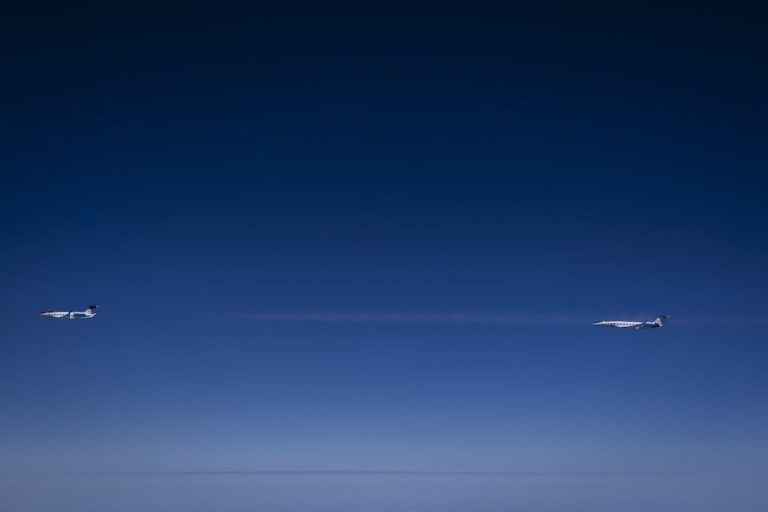
The campaign marks the first flight on 100% SAF for the Gulfstream G800 and its Pearl 700 engine. The G800 flew in close formation with a specially modified Gulfstream G700, converted into a flying emissions measurement laboratory. This enabled researchers to record particulate matter and contrail-forming atmospheric characteristics at altitudes higher than most commercial airliners operate but typical for business aircraft.
The campaign was conducted in collaboration with the FAA’s Center of Excellence (ASCENT), NASA, the German Aerospace Center (DLR), Missouri University of Science and Technology, Aerodyne Research, Rolls-Royce, Montana Renewables and World Fuel Services. It was designed to isolate how fuel composition influences non-CO2 emissions.
The team compared conventional Jet A, low-sulfur Jet A and neat hydroprocessed esters and fatty acids (HEFA) SAF, which contains no sulfur or aromatics. Gulfstream said that preliminary results indicate a “significant” measurable reduction in the particulate emissions that contribute to contrail formation when operating on neat SAF.
Gulfstream’s engineering and flight test teams put in months of preparation for the study, including modifying the G700 cabin to integrate advanced inflight emissions instrumentation. Pilots trained extensively in simulators to execute complex formation profiles needed to capture both near-field emissions and contrail evolution several miles in-trail.
Mark Burns, president of Gulfstream, said: “As aviation continues its work in optimising environmental efficiencies, Gulfstream is focused on advancing solutions that deliver measurable impact today while shaping a more sustainable future for flight. This campaign reflects our strategy to lead with advanced technology, real-world testing and meaningful collaboration to better understand and reduce aviation’s environmental impact.”
Rich Moore, a research scientist at NASA, said: “This collaboration enabled these first-ever high-altitude 100% SAF emissions observations, allowing the team to operate safely and efficiently while maintaining the precision needed for accurate data collection. This real-world data is essential to improving our models and understanding aviation’s broader environmental impact.”
Julie Marks, executive director of the FAA’s Office of Environment and Energy, said: “Partnering with Gulfstream was an excellent opportunity that will help inform and quantify our efforts to mitigate the impacts of persistent contrails. We appreciate the collaboration with industry as the FAA continues to evaluate how SAF may help reduce persistent contrails.”
The data from the campaign will be utilised in partnership with the broader aviation and atmospheric science communities. It is planned that these insights will be used to help refine analytical models, inform future fuel standards and support the development of operational strategies to reduce aviation’s environmental impact.
To date, Gulfstream aircraft have flown more than 3.5 million nautical miles on SAF blends.