

According to new research commissioned by Airbus Corporate Jets (ACJ), demand for business aircraft in Asia will keep rising through the rest of the decade, particularly in the large cabin segment.
Of the business aviation financiers and brokers surveyed across Asia, 85% expect purchases of large business jets to increase between now and 2030 – including 30% who expect a dramatic increase.
The global survey also points to a shift towards larger aircraft: 60% of respondents expect demand for large and midsize business jets to keep growing faster than other business aviation categories through to 2030, and 62% estimate that 65% to 70% of new business jet spending between 2025 and 2034 will be concentrated on large and long-range aircraft.
Aircraft owners are also expected to keep trading up to larger models. Today, 56% of respondents say at least a quarter of the aircraft they are involved in selling or financing represent upgrades into larger aircraft categories, a figure expected to climb to 89% by 2030.
On what drives large-aircraft purchasing decisions, 45% of respondents say buyers place equal importance on increased range and larger cabin space, while 28% identify cabin comfort, passenger capacity and aircraft customisation as the most important considerations, and 27% point to range and mission flexibility as the primary drivers.
Economic factors are also playing a growing role, according to the survey. Respondents identified charter revenue opportunities as the most important commercial factor influencing buyers, followed by residual value and purchase price. Looking beyond acquisition, 40% say operating costs are the most underestimated factor in the purchasing process, while 25% point to residual value.
Confidence in the financial outlook for larger aircraft also remains strong: 67% of respondents believe financing large business jets will become easier than financing smaller aircraft in the coming years, and 75% expect fleet modernisation through newer, more efficient aircraft to keep accelerating over the next five years.
“The business aviation market in Asia continues to demonstrate remarkable confidence, and the actual increase of ACJs in service in Asia is a testimony of this growth,” said Chadi Saade, president of ACJ. “Buyers are increasingly looking for aircraft that deliver long-range capability, greater flexibility and a premium onboard experience, while also offering strong long-term economic performance.”
“Purchasing decisions today are far more strategic, with customers considering operating costs, financing, charter revenue opportunities and residual value alongside traditional measures such as cabin size and range,” Saade continued. “The trend towards larger, more capable aircraft reflects the increasingly global nature of business. Operators want aircraft capable of flying longer missions while providing passengers with the space and comfort expected of a modern business jet.”
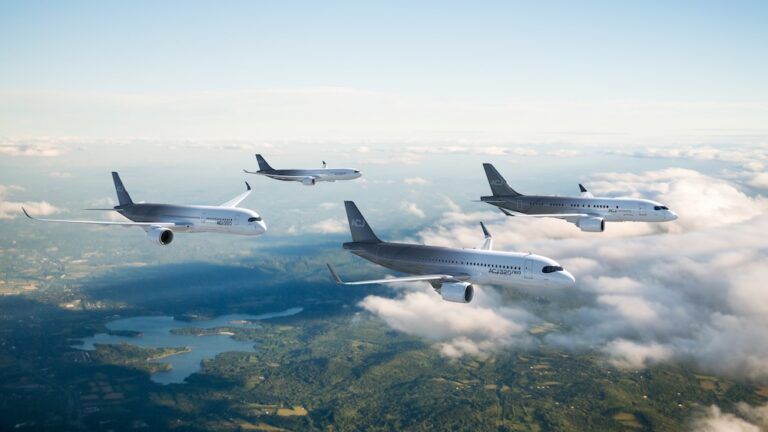
ACJ’s range spans the ACJ TwoTwenty and ACJ320neo through to the widebody ACJ330neo and ACJ350. The ACJ TwoTwenty, which the manufacturer positions in a segment it calls the ‘Xtra Large Bizjet’, “offers twice the cabin real estate compared to similarly priced ultra-long-range business jets” ACJ said. The manufacturer also said that the aircraft “occupies the same parking footprint as competitive ultra-long-range jets and can take off from the same airports, but the ACJ TwoTwenty operating costs are one-third less”.
With a range of up to 5,650nm (more than 12 flight hours), the ACJ TwoTwenty can meet the requirements of 98.6% of Asia departures, according to ACJ’s analysis of JETNET data from February 2025. ACJ said that like all its aircraft, the TwoTwenty can fly on a blend of up to 50% sustainable aviation fuel (SAF) and kerosene while keeping to the technical specifications of Jet A fuel.
The research was conducted in May 2026 by independent research company Pureprofile on behalf of ACJ, surveying 60 business aviation financiers and brokers across Asia, all working for organisations that own or use business aircraft.