

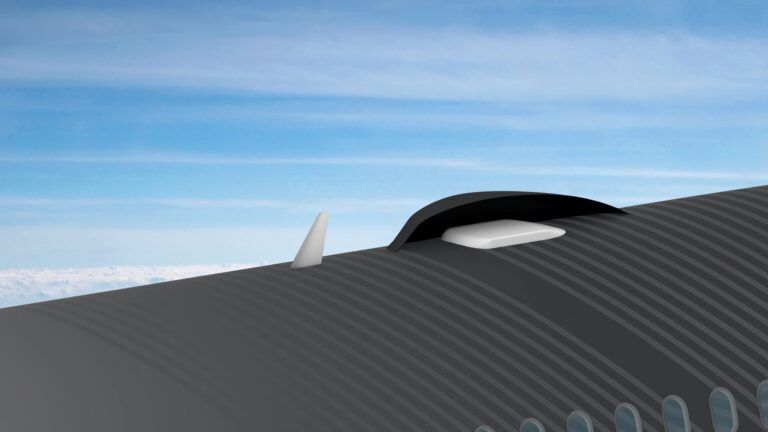
On 11 May, EASA certified Gogo’s Galileo Full-Duplex (FDX) connectivity system on the ACJ320 and ACJ320neo. The system, which was first announced in February 2025, uses a flat electronically steerable antenna and runs on Eutelsat OneWeb’s low-earth orbit (LEO) satellite network.
The FDX certification builds on the introduction of Gogo Galileo’s Half-Duplex (HDX) solution last year. HDX offers speeds of up to 60Mbps download and 11Mbps upload, while FDX delivers up to 195Mbps download and 32Mbps upload.
Both systems use Eutelsat OneWeb’s LEO network of more than 640 satellites. The LEO satellites fly closer to Earth than traditional satellites, designed to offer faster speeds, lower latency and global coverage including the poles.
“We are delighted to be among the first corporate aircraft manufacturers to offer and support a certified, fully integrated LEO inflight connectivity solution,” said Chadi Saade, president of Airbus Corporate Jets. “Achieving this certification for Gogo’s FDX offers our ACJ Connect customers a new low-latency high-bandwidth choice and consolidates the ACJ320 Family’s position as offering industry-leading business aviation connectivity.”
“The addition of the Gogo Galileo FDX gives ACJ’s customers the certainty of reliable, high-speed connectivity throughout all phases of flight, wherever they are flying,” added Michael Skov Christensen, Gogo chief commercial officer.
Compared with the HDX solution, FDX features a larger full-duplex ESA antenna with two arrays: one for data transmission and one for receiving, enabling even higher-speed, low-latency connectivity for the cabin. Meanwhile, the HDX option comprises a single electronically steered array designed to switch constantly and seamlessly between transmit and receive modes, enabling the transfer of data to and from a satellite.
While the Gogo Galileo HDX is designed to enable six or more passengers to simultaneously video call, live stream, use data-hungry apps, email and use corporate networks, the FDX architecture effectively widens the data pipe into the aircraft to serve even more passengers using data heavy applications all at once. By allowing data to be transmitted and received simultaneously, more data-intensive applications can be optimised for more passengers.