


Christelle Dietsch, manager of interior design at AMAC Aerospace, shares all about a transformable chaise longue recently created for a private jet.
What’s your favourite detail from a recent design?
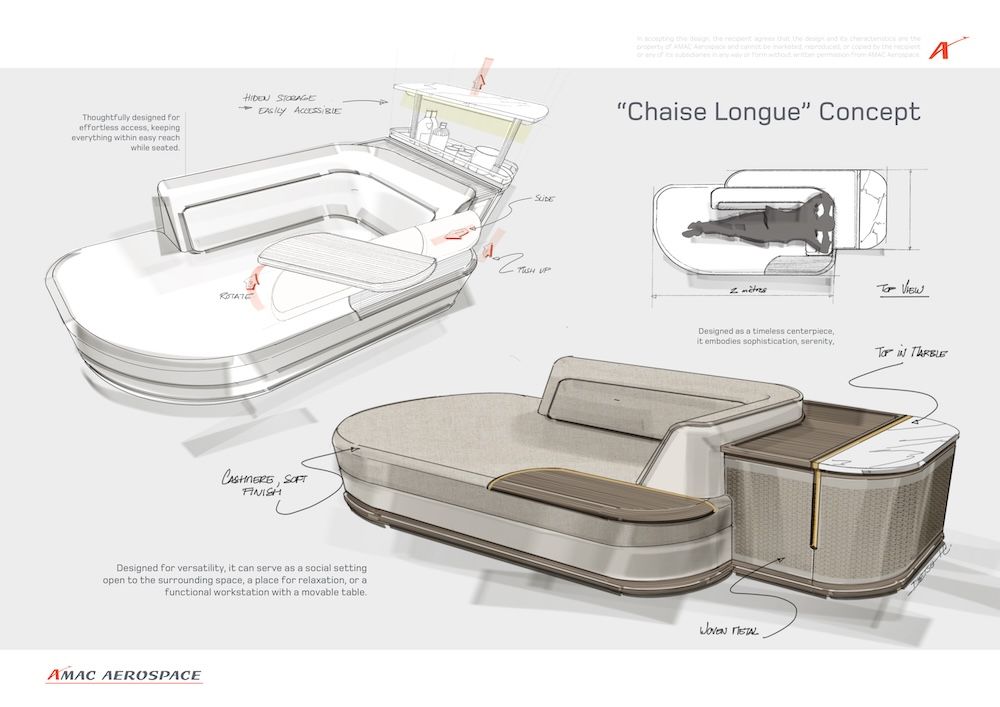
It is a bespoke chaise longue area developed as part of a private jet cabin. The project began, as always, with an in-depth dialogue with the owner to understand how he lives in his aircraft – how he relaxes, works, socialises and moves within the space. Design is not simply about shaping forms or selecting materials; it is about elevating the overall onboard experience and aligning it precisely with the client’s lifestyle and expectations.
The ambition was to create a multifunctional zone that allowed the owner to relax, read, work or engage socially while remaining visually and physically connected to the main cabin activity. The chaise longue emerged as a natural response – an elegant feature that preserves spatial flow while offering a comfortable, reclined position.
Two additional requirements shaped the concept: seamless access to a nearby bar area and the integration of a functional work surface. The primary challenge lay in incorporating these elements as discreetly as possible, particularly the table, which needed to be fully adjustable and usable from multiple seating positions. Close collaboration with engineering teams was crucial in developing a mechanism that allowed fluid, precise movement while remaining visually minimal. The objective was clear: the function should appear effortless, almost intuitive – engineering excellence expressed through apparent simplicity.
Throughout the development, maintaining a balance between innovation and realism was key. While it is important to push creative boundaries, the design must also respect budget parameters, certification requirements, maintenance considerations, and the strict regulatory framework of aviation. It is our responsibility to anticipate potential operational or technical challenges early in the process.
What can be learnt from this project?
There is strong potential to further develop this concept, particularly by adapting it to meet TTOL requirements – an evolution that would introduce additional constraints but also open new opportunities for innovation in comfort, flexibility and functionality within the cabin environment.
What crafts, materials or ideas are you keen to explore this year?
I am particularly interested in exploring adaptable design solutions inspired by the residential sector, where innovation allows spaces and furniture to transform effortlessly. In aviation, multifunctionality is essential, as an aircraft must accommodate very different uses. The ability to convert a divan into a bed or subtly reconfigure a layout is key.
Translating these concepts into the highly regulated aviation environment presents technical challenges, especially regarding certification and weight constraints. This is where advanced mechanisms, closely linked to material innovation, become crucial. New lightweight and high-performance materials allow us to push boundaries and develop solutions that were previously not achievable.
This interview was first published as part of the European Design Forum in the March/April 2026 edition of Business Jet Interiors International. Four private jet interior designers based in Europe were invited to share key details from recent projects.