

Designer Alicja Kotlarek shares all about the striking Sigma Nera concept – including the design decisions that make the dark palette work.
This dark, dramatic and immersive Gulfstream G650 concept was developed as an entry for a design competition by Alicja Kotlarek, and conceived as an answer to more conventional business aviation designs. “It is imagined as playful, indulgent and unapologetically different, designed for people who are comfortable standing apart and embracing a more expressive form of luxury. The goal was to move away from traditional light aviation interiors and instead create an environment that feels nocturnal, cinematic and emotionally charged.”
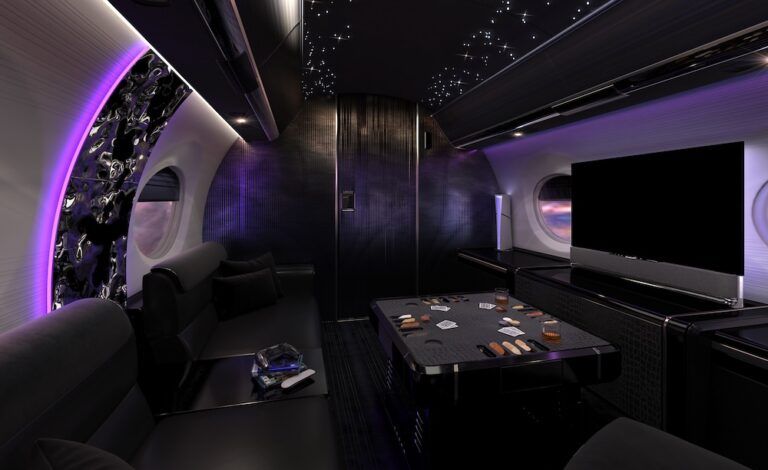
Inspirations came from high-end automotive interiors, luxury nightclubs and contemporary yacht interiors, “where darker palettes are used to heighten intimacy and material richness”, says Kotlarek. Accents of violet and subtle metallic highlights were introduced to create depth, rhythm and a sense of controlled energy rather than visual noise.
Working with such a dark palette has its challenges, as Kotlarek explains: “Dark interiors can easily feel heavy, enclosed or visually flat, especially in an aircraft cabin. This was addressed through layered lighting rather than general illumination. Contrasting textures and reflectivity levels keep surfaces visually active. Careful control of sheen versus matte finishes prevents the space from absorbing too much light. The darkness becomes intentional and atmospheric rather than overwhelming.”
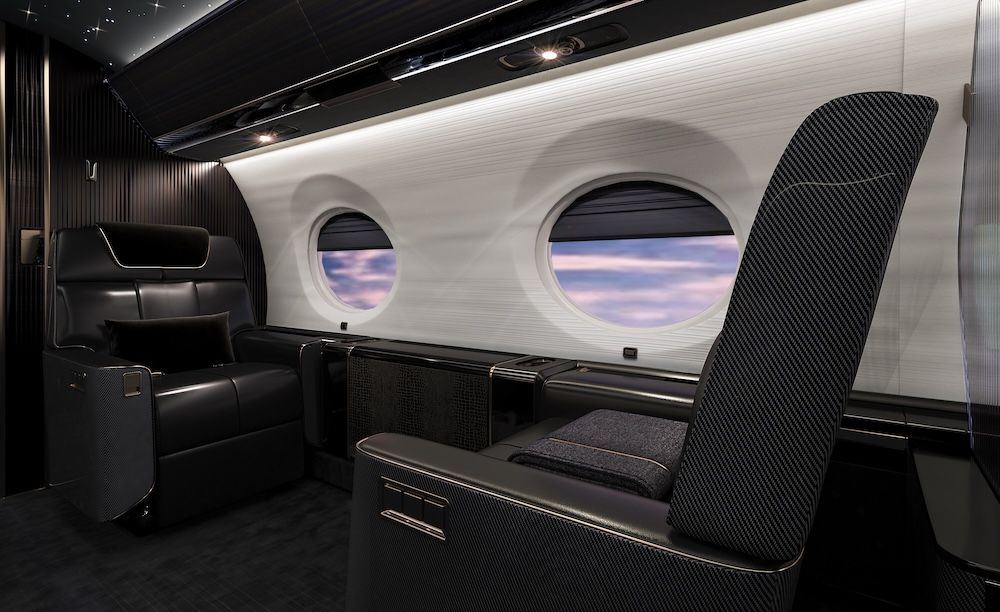
To create a variety of textures that interact differently with light, the CMF selection includes carbon fibre with a subtle directional weave, high-gloss and satin lacquered panels, textured stone-like finishes, soft leather upholstery and smooth velvet flooring. “In a dark environment, texture becomes the primary design language,” explains Kotlarek. “The contrast prevents monotony and enhances perceived luxury.”
Kotlarek says the complex lighting control systems would be the most challenging elements to integrate. “All reflections, glare and the ceiling system must be managed within regulatory limits,” she says. “However, all elements are conceived with certifiable materials and processes in mind and could be realised with collaboration from an experienced completion centre.”
Some of the standout details include:
Star effect ceiling
This is a deliberate contrast to the dark palette, symbolising freedom, risk and imagination. “I tried to treat the lighting as an architectural and emotional tool, not just a functional one,” says Kotlarek. “I wanted a cabin that feels alive and adaptable.”
Carbon fibre
Kotlarek’s personal favourite material is used for details here and there, with a subtle directional weave. “I frequently use carbon fibre in yacht design, bringing a sense of speed, strength and elegance,” she says.
Poker table
The poker table is included as a metaphor for risk, chance and courage – the emotional core of the project. It is designed as a multifunctional module rather than a fixed “novelty” element, converting into a standard table when not in use. It also incorporates hidden storage for chips and accessories and is securely fixed for compliance with aviation safety requirements. “Flexibility was essential to ensure the concept remains realistic rather than purely theatrical,” says Kotlarek.
This feature was written by Izzy Kington and first published in the March/April 2026 edition of Business Jet Interiors International.